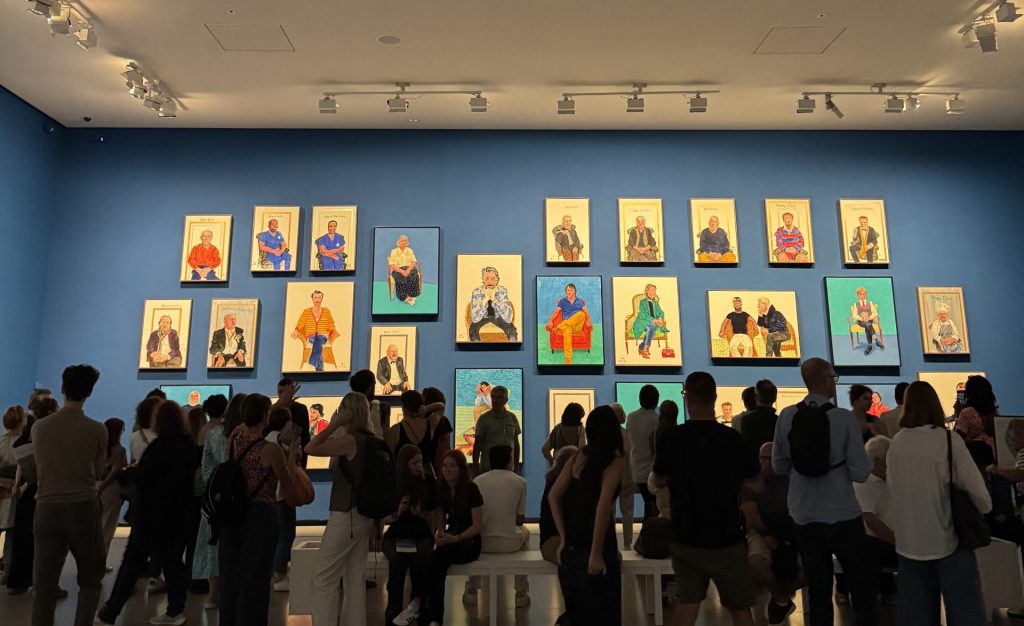
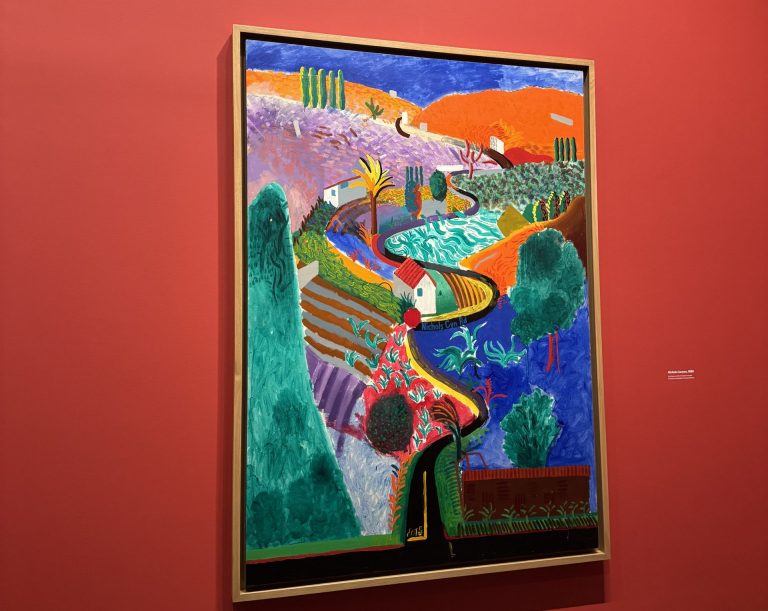
With a career spanning 70 years and counting, we ventured out of the UK to David Hockney’s Paris exhibition at the Fondation Louis Vuitton. At his extensive Parisian exhibition, we saw over 400 of the northern artist’s works from 1955 to 2025.
Born in 1937 and raised in postwar Bradford, Hockney decided at age 11 that he wanted to be an artist, and so his love for art began. And then in 1959, Hockney headed south to study at the prestigious Royal College of Art in London. Taking inspiration from the beauty of the world and the people around him, Hockney’s many pieces focus on nature and the people in his life. From Yorkshire to California, Hollywood, Paris, Normandy and London, the exhibit takes us around the world with Hockney. But one thing never wavers: his undeniable passion for art.
Held from 9 April to 31 August 2025, the exhibition took us through the artist’s various styles over the years – even delving into his more recent digital work. From Californian-inspired oil on canvas to charcoal Yorkshire landscapes and iPad drawings, Hockney’s range of experimentation has most certainly moved with the times.
At the start of the exhibition, we are presented with the less colourful, more industrial side to Hockney’s early work, which is said to be reminiscent of French painter and sculptor Jean Dubuffet. Here, there was also a portrait of Hockney’s Father displayed, which was originally shown at Leeds Art Gallery in 1957. His early oil artwork can also be seen to draw on other inspirations, such as graffiti art, and is a stark contrast to his later, extremely vibrant, abstract work.
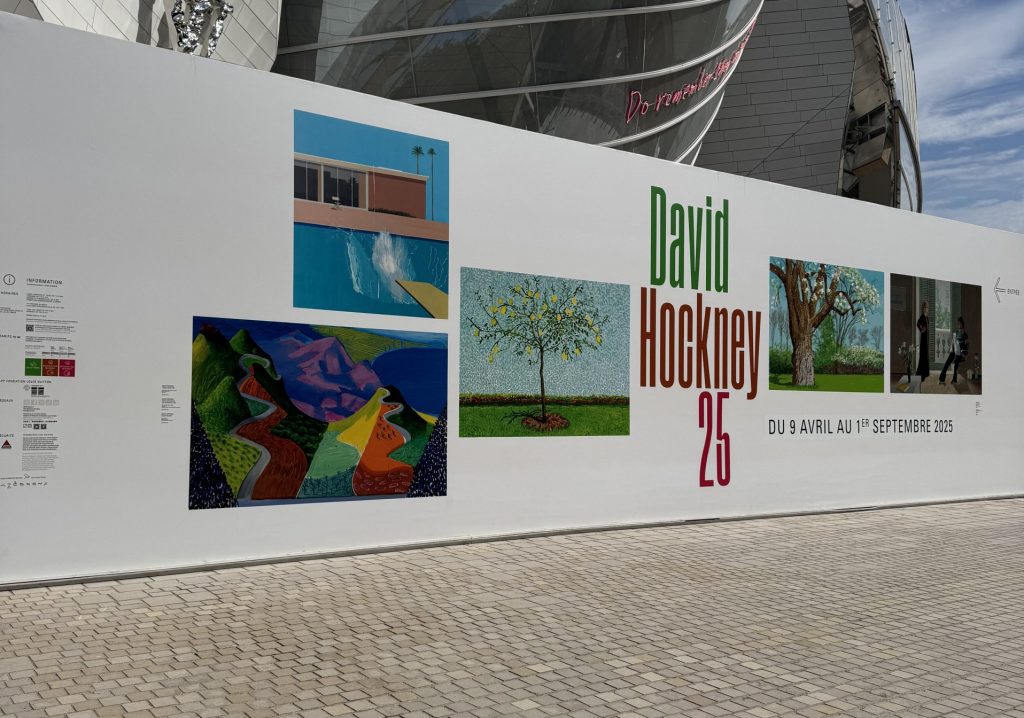
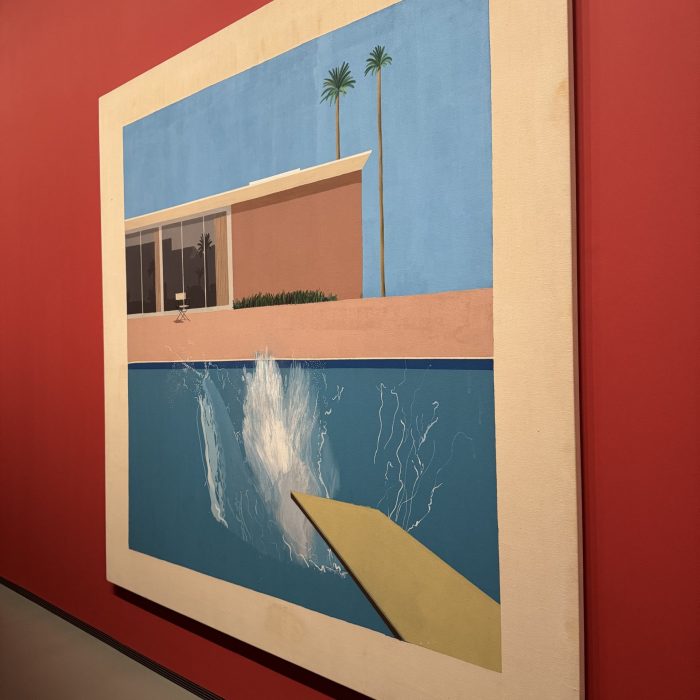
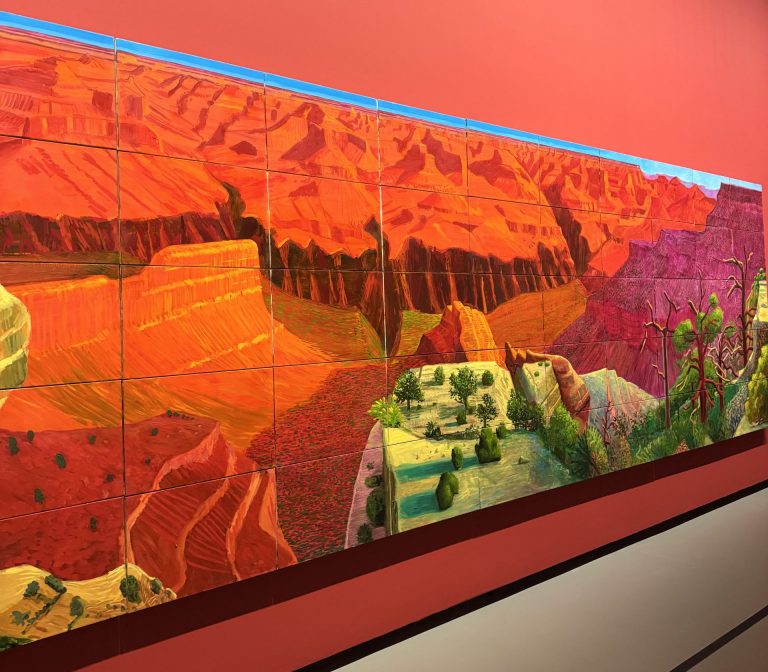
The next segment of the exhibition has viewers greeted with Hockney’s move to Los Angeles in 64’, where he became heavily influenced by sunny California. At this time, Hockney became an icon and a leading figure on the 60s art scene thanks to his bold use of colour and experimentation with lighting. Possibly one of his most well-known pieces, the 1967 A Bigger Splash is as simplistic as it is bold, but there was something about seeing his 1998 oil piece A Bigger Grand Canyon in all of its 60 canvas glory that was insanely impressive. The American landscape dwarfed everything else in the room and spanned the entirety of one red wall.
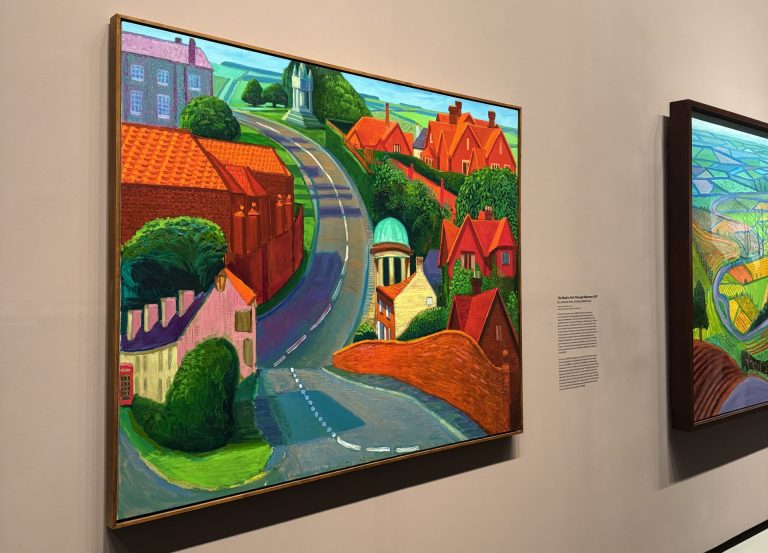
In the late 90s, Hockney returned to Yorkshire and settled there after his Mother passed. His ties to the landscape back home in the North of England are embodied in his work from 1997 to 2013. Capturing the seasons and their variations, the use of watercolour and charcoal makes an appearance in several of his English landscape pieces. However, his 1997 oil painting, The Road to York through Sledmere, transports you into a world of winding roads through the rich colour palette, and it was one of our personal favourites in the collection. Another wildly impressive piece was the fifty canvas work completed by Hockney in just six weeks – the largest of his art to date. The 2007 Bigger Trees near Warter looks at the changing landscape featuring a large sycamore tree in the centre. Loaned by the Tate, the artwork spanned 180 by 480 inches, and it was definitely a sight to behold.
The French exhibition also uncovered Hockney’s love for opera and how he had been commissioned to create sets and costumes for the opera-fable The Rake’s Progress by Stravinsky. To quote Hockney himself: “We need more of the opera. It is bigger than life.”
In later life, Hockney moved onto 3D photography, playing with perspective, as well as digital art and working on his iPad, where he created a staggering 220 ‘iPad paintings’, including his ‘flower portraits’ – which were also displayed in the gallery. However, he has not given up on traditional painting, and for that, we are grateful.
When asked by the BBC, “Looking back, that child growing up in Bradford, would he ever have imagined the life you had?”
Hockney responded, in his Yorkshire twang: “He’d have thought it was pretty daft.”
Featured image and all images included by Meghan Glover.